v0 by Vercel is a UI generation tool. It is very good at that specific job. You describe a component or a screen, and v0 produces clean, styled React code you can drop into a project.
Developers looking for a v0 alternative are usually looking for something beyond that scope. They need a backend. They need auth. They need a database that persists real data. They need a pipeline that does more than output code.
This article covers what v0 is built for, where its scope ends, and how IronFlyer covers the rest of the stack.
TL;DR: v0 vs IronFlyer
| Capability | v0 | IronFlyer | |---|---|---| | Scope | UI component generation | Full-stack: frontend, backend, auth, workers, deploy | | Workspace | No runtime environment | Hardened Linux Docker workspace per project | | Deployment | Vercel-first | Your own Vercel project, or a static artifact on your domain | | Cost model | Vercel subscription | Prepaid wallet in dollars, reserved before each step | | Gate system | None | ProfitGuard before every expensive call | | Security scanning | None | A 15-scanner gate with veto power | | Backend support | None | Go, Node/Express, NestJS, FastAPI, Flask blueprints | | Record | None | Patches, gate verdicts and an append-only cost ledger |
---
What v0 is built for
v0 is Vercel's AI UI generation product. It takes a text or image prompt and outputs React component code, typically using Tailwind and shadcn/ui as the styling layer.
The output is immediately usable. You paste it into your existing Next.js project, adjust the props, and move on. For frontend engineers who work in the Vercel ecosystem and need to move fast on UI work, v0 is a real productivity tool.
It is honest about its scope. v0 does not claim to build backends. It does not claim to produce a deployable application. It generates components. The Vercel integration lets you preview them, but the path from preview to production is still your responsibility.
That clarity is actually one of v0's strengths. It does one thing and does it well.
---
What v0 does not cover
The constraint is not a bug — it is the design. v0 is a component generator, not an application builder. That distinction matters when you are trying to ship a product.
No backend. v0 produces frontend code. An application that authenticates users, persists data, processes payments, sends emails, or runs background jobs needs a backend. v0 does not generate one.
No auth. User accounts, sessions, JWT handling, OAuth flows, password reset — none of this is in v0's scope. You bring your own auth layer. v0 outputs the UI for a login form; it does not produce the backend that handles the login.
No cost gates. v0 runs on your Vercel subscription. There is no pre-execution budget check. There is no mechanism that asks whether the next generation step is worth the spend. You request, it generates, you see the usage in your account.
No gate pipeline. v0 does not run security or quality checks against the code it produces. The output is reasonable React code, but there is no automated scan for leaked credentials or vulnerable dependencies, and no review step before the code reaches your repository.
No deploy pipeline. Vercel's native deployment is excellent for frontend applications. But v0 itself does not manage the deploy — it generates code, and deployment is a separate Vercel workflow.
No real workspace. v0 has no persistent runtime environment. It does not run code. It generates code. The preview in v0's interface is a render of the component, not a live application.
---
How IronFlyer covers the full stack
IronFlyer starts where v0 ends.
UI generation is one part of what IronFlyer does. But IronFlyer also builds the backend, wires up auth, writes database migrations, sets up API routes, configures background workers, and ships the finished artifact.
All of this runs inside a real Linux Docker workspace that persists for the life of the project.
Real workspaces mean real builds. When IronFlyer generates a backend service, it runs it in the workspace. It runs the migration. It starts the server. The workspace is not a rendering environment for a preview — it is a real Linux environment where real build commands run, on its own isolated network, with all Linux capabilities dropped, no-new-privileges set, and explicit CPU, memory and process limits.
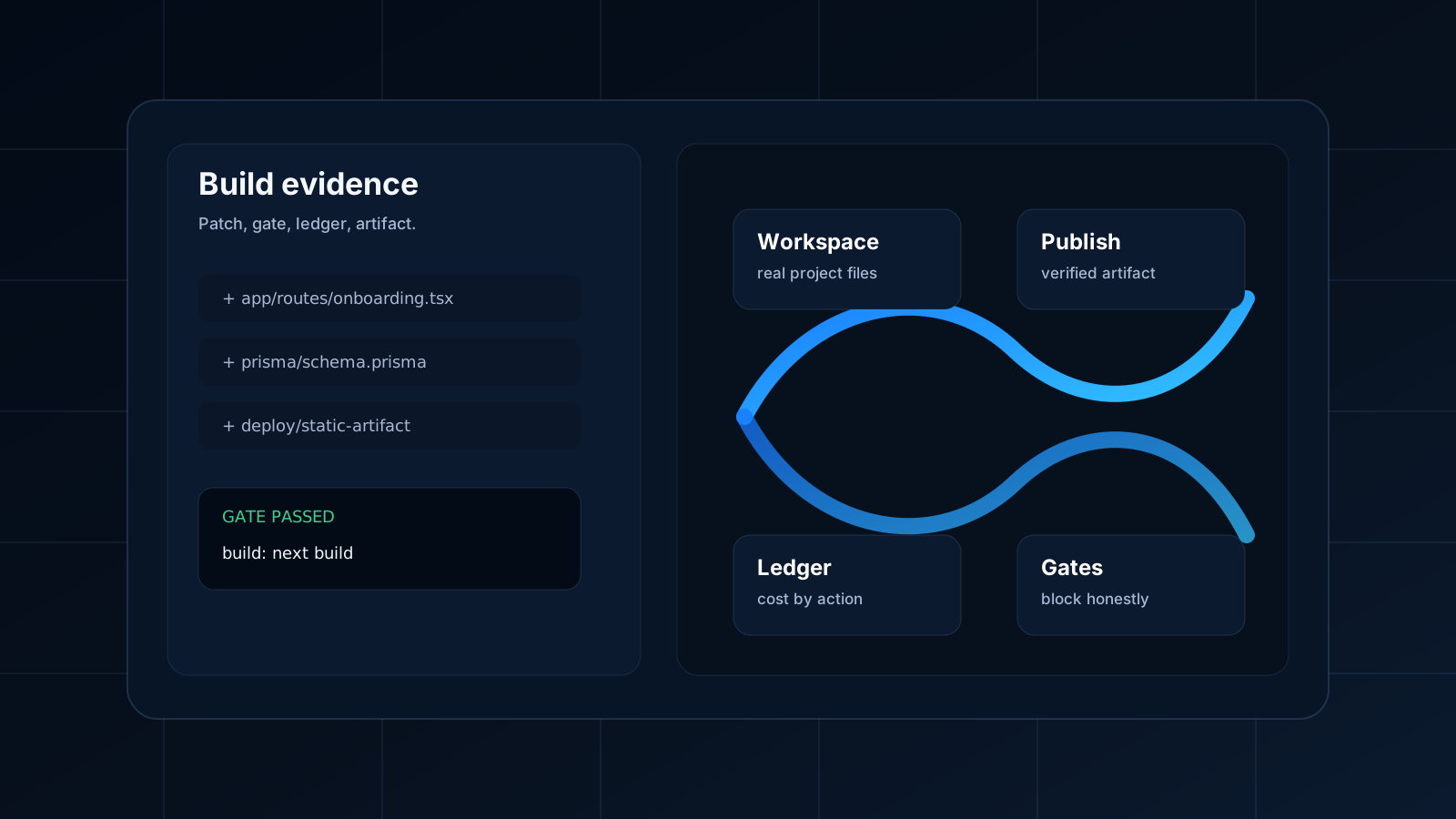
The gate pipeline is the quality bar. Every change IronFlyer makes to your project is a patch proposal. Before the patch applies, an LLM critic reviews it and a fifteen-scanner security engine scans it — Semgrep, Gitleaks, Trufflehog, Trivy, Govulncheck, OSV-Scanner, Syft, ScanCode and npm audit among them. Critical and high findings block the build and are shown with their file, line and rule; medium and low surface as warnings. ProfitGuard runs before any expensive operation to check that the wallet can fund the next step and that the step is worth taking.
A deploy that lands in your account. IronFlyer deploys into your own Vercel project, or produces a static artifact you host yourself. Custom domains are verified by DNS and get certificates issued and renewed automatically, and the domain binds to a deployment rather than to a project — so a rollback moves the domain with it. Deploy is a node inside the gated pipeline; nothing ships that failed the security gate, and production promotion waits for an explicit human approval.
Cost is tracked per execution. Every IronFlyer execution has a cost record — model tokens, sandbox time, build minutes, deploy operations — written to an append-only, double-entry ledger. The wallet is prepaid and held in dollars, and each step reserves funds before running.
---
Four specific comparisons
1. Scope: UI component vs. full application
v0 produces a React component. You receive JSX, Tailwind classes, and props. You integrate it into your project manually.
IronFlyer builds the full application. The AI generates the frontend and the backend together. It writes the data model, the API, the auth layer, and the component that consumes the API, then runs them in the workspace to verify they connect.
2. The backend question
v0: no backend.
IronFlyer: the backend is a first-class build target, with production blueprints for Go HTTP APIs, Node/Express, NestJS, FastAPI and Flask. The AI writes the database schema, runs migrations, and exercises the endpoint in the workspace before proposing the patch.
3. Deployment
v0: generate the component, push it to your Vercel project through standard Vercel CI.
IronFlyer: the deploy step is inside the execution. The AI generates the code, builds it, verifies it in the workspace, and then ships the artifact to your configured target. You configure the target once, and subsequent builds go to the same place.
Worth saying plainly: IronFlyer is not a way to escape Vercel. Vercel is a first-class deploy target here, and the honest alternative to it today is a static artifact you host wherever you like. What changes is ownership of the pipeline — the build is gated, costed and recorded before anything reaches the target.
4. Review and gate pipeline
v0: no pipeline. The code arrives in your interface. You copy it or sync it to a GitHub repo.
IronFlyer: every change is a diff with a gate record attached. The security and quality gates run automatically, and you see the verdict before the patch applies. Patches, gate runs and findings are stored, so a later reader can reconstruct what changed and what the gates said.
---
When to use each
Use v0 when:
- You need a UI component quickly and you already have a backend.
- You are working in a Vercel and Next.js project and want to generate new screens without interrupting your workflow.
- You want to explore layout or interaction options visually before writing the final component yourself.
- You are comfortable owning the integration, the backend, and the deployment.
v0 is a frontend engineer's tool. It works best when you already have the surrounding system and you just need the UI output fast.
Use IronFlyer when:
- You need the full stack built, not just the UI.
- You need a pipeline that ends at a deployed artifact, not a component in a file.
- You need cost accountability — a wallet that reserves before each step, a ledger that records after.
- You need a review trail — patches with gate verdicts, not direct AI edits.
- You need generated code to be scanned before it lands.
- You have a v0-generated frontend and now need the backend to go with it.
---
Frequently asked questions
Can IronFlyer use v0-generated components as a starting point?
Yes. You can import components generated by v0 into an IronFlyer project. The AI reads the existing component structure and builds the backend, data layer, and routing around it. Every subsequent change goes through the patch and gate pipeline.
How does IronFlyer handle Vercel deployments?
IronFlyer supports Vercel as a deployment target. Configure your Vercel project and API token once, and the deploy node in each execution ships to that project. Production promotion requires an explicit approval by default.
What makes IronFlyer's wallet model different from Vercel's subscription?
Vercel charges a monthly subscription for v0 usage. IronFlyer's compute is drawn from a prepaid wallet held in dollars. Each execution reserves funds before running, and if the balance is insufficient the step does not start — the API returns 402 INSUFFICIENT_FUNDS with a top-up URL. See IronFlyer pricing for current plans and wallet terms.
Does IronFlyer produce Tailwind and shadcn/ui components like v0 does?
IronFlyer can generate components with any styling approach, including Tailwind and shadcn/ui. The AI picks the styling layer based on the project's existing stack. If you bring a v0-style Tailwind project into IronFlyer, the AI continues in the same style.
---
If you have UI components and now need the backend and deploy pipeline to go with them, start a build in IronFlyer.
Read our comparisons with Bolt.new and Lovable to see where IronFlyer sits in the broader AI builder landscape.