Lovable earned its reputation. It produces clean, shareable React applications fast. The demo-to-stakeholder pipeline is short. The visual output is polished.
Developers and founders who look for a Lovable alternative are not usually unhappy with that first mile. They run into a ceiling somewhere between "this looks great" and "this is live in production."
This article names that ceiling specifically. It covers what Lovable does well, where it stops serving you, and what IronFlyer offers in its place.
TL;DR: Lovable vs IronFlyer
| Capability | Lovable | IronFlyer | |---|---|---| | Gate system | None | ProfitGuard before every expensive call | | Cost control | Subscription plus usage, billed after | Prepaid wallet in dollars, reserved before each step | | Build discipline | Prototype-speed, no enforcement | Security and quality gates on every patch | | Security scanning | None | A 15-scanner gate with veto power | | Tech stack | React plus Supabase (guided) | Production blueprints across Next.js, React, Vue, Svelte, Angular, Go, Node, NestJS, FastAPI, Flask | | Patch review | Direct AI edits | Proposed diff, gate-verified, then applied | | Deployment | Lovable hosting or Supabase | Your own Vercel project, or a static artifact on your domain | | Real workspaces | No | Hardened Linux Docker workspace per project |
---
The Lovable ceiling
Lovable is genuinely good at one thing: turning a description into a visually complete React application, fast.
The first run often impresses. The UI is clean. The component structure is reasonable. For a founder who needs to show a concept to investors, a co-founder, or early users, Lovable delivers.
The ceiling appears when you need the application to do real work.
No cost gates. Lovable runs AI inference on your behalf and charges a monthly subscription, with usage above your tier billed additionally. At no point before an operation does the system pause and ask: is this step funded? Is the expected value of this AI call positive? There is no wallet reservation. You find out what you spent after the billing cycle closes.
For a solo founder running a tight experiment, this may be fine. For a team running many builds a week, the billing surprise risk is real.
No patch review system. When Lovable's AI generates or modifies code, it applies the change directly. The developer sees the diff in the file view, but the change has already happened. There is no proposal step. There is no approval gate. There is no security scan between the AI's intent and the code that lands in the file.
This works fine when the AI is correct. When the AI makes a wrong assumption — a wrong schema change, an incorrect API integration, a destructive migration — you find out after the fact.
Limited backend depth. Lovable is built around the Supabase stack. Supabase is a good choice for many applications, and the integration is well-executed. But it is a single choice. If your project needs a custom backend in Go, a background worker in Python, a non-Supabase Postgres setup, or a custom microservice, Lovable does not serve that use case well.
Billing shape. Lovable charges monthly. Some months you build a lot. Some months you do not. IronFlyer's compute comes out of a prepaid wallet held in dollars, reserved before each step and settled at real cost, which is a different shape of commitment. Which one suits you depends on your build cadence — see pricing for the current terms on both sides of that trade.
---
What IronFlyer offers instead
IronFlyer starts from a different assumption: the most important property of an AI build is whether it produces something that can run in production, not something that looks good in a preview.
That shapes every design decision.
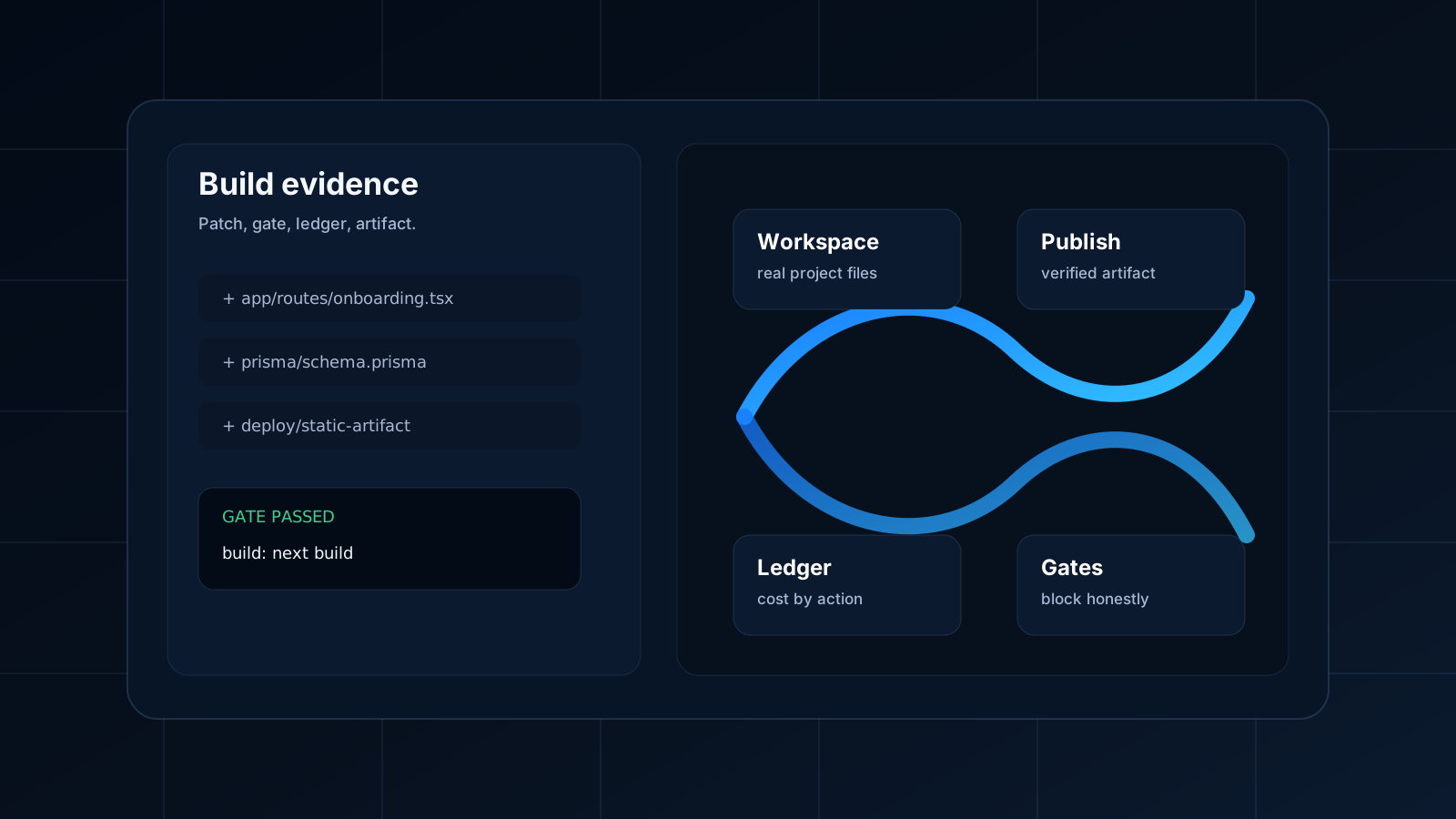
A wallet that reserves before each step. Fund the wallet, in dollars — not in an invented credit unit whose exchange rate you have to learn. Every expensive operation checks the balance before running. The reservation, the ledger entry and the job enqueue happen in one database transaction, so there is never money held against work that was not queued. At settlement the hold is captured at real cost or released, and settlement always runs — on success, on failure, and on cancellation.
Every change is a patch proposal. The AI does not edit code directly. It proposes a diff describing what changes and why. An LLM critic reviews it, and a fifteen-scanner security engine scans it — Semgrep, Gitleaks, Trufflehog, Trivy, Govulncheck, OSV-Scanner, Syft, ScanCode and npm audit among them. Findings arrive with severity, file, line and rule. Critical and high findings block; medium and low are surfaced as warnings. Nothing is applied that you did not see.
ProfitGuard before every expensive call. ProfitGuard is the economic gate inside IronFlyer. It runs before premium model calls, before sandbox allocations, before long verification loops, before deploys — before the spend, never after. It returns continue, degrade to a cheaper model, switch provider, pause for budget, reuse a blueprint, reuse a repair, or stop. If the wallet is short, the API returns 402 INSUFFICIENT_FUNDS with a top-up URL. The AI does not decide on its own to spend money.
The most useful verdict is the unglamorous one. Degrading to a cheaper model matters more than it looks, because the realistic alternative is usually not a more expensive model — it is a failed build you still waited for.
Hardened Linux Docker workspaces. Every IronFlyer project runs in a Docker container with a real Linux environment. You can run a real Postgres instance, a real Redis server, a real Node process, and install any system package your application needs. Each workspace gets its own isolated Docker network rather than sharing a bridge with every other tenant; all Linux capabilities are dropped, no-new-privileges is set, and CPU, memory and process limits are explicit. The workspace is not a simulation, and it is not a shared playground.
Real backend blueprints. IronFlyer ships production blueprints covering both ends of the stack — Next.js, React with Vite, Vue, Svelte and Angular on the front, Go HTTP APIs, Node/Express, NestJS, FastAPI and Flask on the back, plus admin-CRUD and storefront shapes. Blueprint selection is a Decision Engine call, not a dropdown.
---
Five specific capability comparisons
1. How cost is managed
Lovable: monthly subscription, usage metered after the fact.
IronFlyer: prepaid wallet. The system reserves funds before each expensive step. The ledger is append-only and double-entry — entries are never updated and never deleted — and records each cost line as it materializes: tokens, sandbox time, build minutes, deploy operations.
2. What happens when the AI is wrong
Lovable: the change is applied. You see it in the file view. You can undo, but the diff is already live.
IronFlyer: the AI generates a patch proposal. Security and quality gates run against the proposal. If a gate finds a problem — a leaked credential, a vulnerable dependency, an unsafe sink, a missing auth check on a mutating route — the proposal is blocked with a specific finding naming the file, line and rule. The change does not reach your codebase until it clears the gate.
3. Backend capabilities
Lovable: optimized for the Supabase stack. Creating a custom backend service outside that stack requires exporting the code and building it yourself.
IronFlyer: the AI can scaffold a full backend — auth, database schema, API routes, background workers, webhook handlers. These run in the real Linux workspace, and the build step compiles and tests them there before deployment is proposed.
4. The record
Lovable: there is no per-change audit trail that records what the AI proposed, which gates ran, and what the verdict was.
IronFlyer: patches, gate runs, findings and approvals are stored, alongside an append-only ledger of what the work cost. Later — when you are handing a codebase to a new engineer, preparing for a security review, or answering diligence — that record is there to read.
5. Deployment ownership
Lovable: Lovable hosts the application or integrates with Supabase hosting. Moving off the platform requires manual effort.
IronFlyer: the deployment target is yours. IronFlyer ships into your own Vercel project, or produces a static artifact you host where you like. Custom domains are verified by DNS with certificates issued and renewed automatically, and a domain binds to a deployment rather than to a project — so a rollback moves the domain with it. Production promotion requires an explicit human approval by default, and no deploy path bypasses the security gate.
---
When Lovable is the right choice
Lovable is the right tool when speed is the primary constraint and the Supabase stack fits your use case.
If you need a working full-stack web application quickly, with a clean UI and a real database, and you are comfortable with the Supabase backend, Lovable delivers.
It is also a strong choice for non-technical founders who want to validate an idea without hiring an engineer. The output is real enough to gather user feedback, and the subscription price is predictable.
The Lovable model works well for applications that live comfortably within its stack. When you stay in the lanes it has built, it is fast and functional.
---
When IronFlyer is the right choice
Choose IronFlyer when the application needs to be production-grade, not prototype-grade.
When you need a custom backend that is not Supabase. When you need a deployment target that is not Lovable's hosting. When you need a cost record for every build your team runs. When you need a gate system that prevents the AI from applying a destructive change without review.
Choose IronFlyer when your project has grown past the prototype stage. The most common transition is: a founder builds an MVP in Lovable, validates it with users, and then needs to add features that require a real backend — custom auth, complex queries, background jobs, multi-tenant data isolation. At that point, the Lovable stack becomes a constraint.
Choose IronFlyer when you are building for an audience that will ask hard questions about the system — investors running technical diligence, enterprise customers asking about security, a co-founder who wants to see the gate verdicts before merging a change.
Choose IronFlyer when you want the spend bounded before it happens rather than explained afterwards.
---
Frequently asked questions
Can I import my Lovable project into IronFlyer?
Yes. Export the code from Lovable and create a new IronFlyer project from the existing codebase. The AI reads the existing structure, the existing schema, the existing components. From that point, every change the AI proposes goes through the patch and gate pipeline. You do not lose the work you did in Lovable.
Does IronFlyer support Supabase?
IronFlyer can work with Supabase as a backend. If your project already uses Supabase, the AI can continue building on that foundation. IronFlyer is also not limited to Supabase — it can work with any Postgres-compatible database, Redis, custom auth systems, and third-party APIs.
How does IronFlyer's wallet compare to Lovable's subscription?
Lovable charges a fixed monthly fee regardless of how much you build. IronFlyer's compute is drawn per execution from a prepaid wallet, which means the cost tracks the work — and it means an uncontrolled build cadence is your risk to manage, which is exactly why ProfitGuard sits in front of every expensive step. See IronFlyer pricing for current plans and wallet terms.
What is a gate verdict and why does it matter?
A gate verdict is the result of an automated check that runs against a patch proposal before it is applied. IronFlyer runs a set of blocking gates covering spec, architecture, UX, code, lint, tests, drift, budget, security and deploy. The security gate is the sharpest: a fifteen-scanner engine with veto power over the ship. A blocking verdict stops the patch with a specific finding. This is the mechanism that prevents the AI from applying a harmful change without it being caught first.
How does IronFlyer keep each internal tool's data isolated?
Every workspace, project, and wallet is owned by one account, and tenant scope is carried from admission rather than recomputed in each resolver — it is additive to the owner check, never a replacement for it. The generated tool runs in its own Docker workspace on its own isolated network. Cross-tenant reachability is treated as a P0 incident class rather than a bug class. That per-tenant boundary is why IronFlyer fits internal business tools that hold real company data.
---
If your project has outgrown Lovable and you need production-grade discipline from the next build forward, start a build in IronFlyer.
Read our comparisons with Bolt.new and v0 to see how IronFlyer fits the full landscape of AI builder tools.