Bolt.new made AI app building feel fast. You describe an idea, and a working prototype appears. For many developers and founders, that speed is exactly what they came for.
But fast is not the same as done. And "done" is where the questions about Bolt start.
If you have shipped something with Bolt and then tried to harden it, the gaps become visible. Cost control is limited. There is no gate system that blocks expensive calls before they run. The output is client-side-rendered code in a browser sandbox, not a real Linux workspace. And when the AI makes a mistake, there is no patch and gate record to audit.
This article compares IronFlyer and Bolt directly. It covers what each tool is built for, where each one stops working, and which one fits which kind of project.
TL;DR: Bolt vs IronFlyer
| Capability | Bolt.new | IronFlyer | |---|---|---| | Cost visibility | None before build starts | Wallet reservation before every expensive call | | Production gates | None | ProfitGuard before spend; gates that block the ship | | Change record | None | Every change is a gate-verified patch with a stored verdict | | Workspace | Browser WebContainer | Hardened Linux Docker workspace, isolated network | | Security scanning | None | A 15-scanner gate with veto power | | Build discipline | Prototype-speed | Gate-enforced, append-only ledger | | Deployment | Bolt-hosted | Your Vercel project, or a static artifact with your own domain | | Backend support | Limited, client-side-first | Real backend blueprints: Go, Node/Express, NestJS, FastAPI, Flask | | Wallet | Subscription | Prepaid wallet, denominated in dollars |
---
Why developers look for Bolt alternatives
Bolt is a strong prototyping tool. Most developers who go looking for an alternative are not dissatisfied with the prototype — they are dissatisfied with what comes after.
Here are the pain points that come up repeatedly.
Cost surprises. Bolt runs AI calls continuously as you iterate. There is no reservation system. You find out what you spent after the fact. For a single-session prototype that is manageable. For a team running dozens of builds a week, it becomes unpredictable.
No gate system. The AI decides what to do next and does it. There is no mechanism that asks: is this call worth the expected cost? Is this build step likely to succeed? Should this retry loop run or stop? Without gates, the system optimizes for the action rather than the outcome.
Client-side-first output. Bolt runs in a browser WebContainer. That works for React frontends. It does not work for applications that need a real Node process, persistent file I/O, compiled binaries, real database connections, or system-level tooling. The workspace is a simulation, not a server.
No security gate. Generated code goes into your project without an automated scan for leaked credentials, vulnerable dependencies, or unsafe sinks. You find out later, or you never find out.
Ownership model. Code lives inside Bolt's environment. Extraction works but is not frictionless. For a production app, most developers want the code running on their own infrastructure from day one.
These are not fatal flaws. Bolt is a fast prototyping tool, and it is honest about that. The problem arises when developers use it for production work and then hit each of these walls in sequence.
---
What IronFlyer does differently
IronFlyer is built on a different premise: a paid AI execution is an economic event, not a chat session.
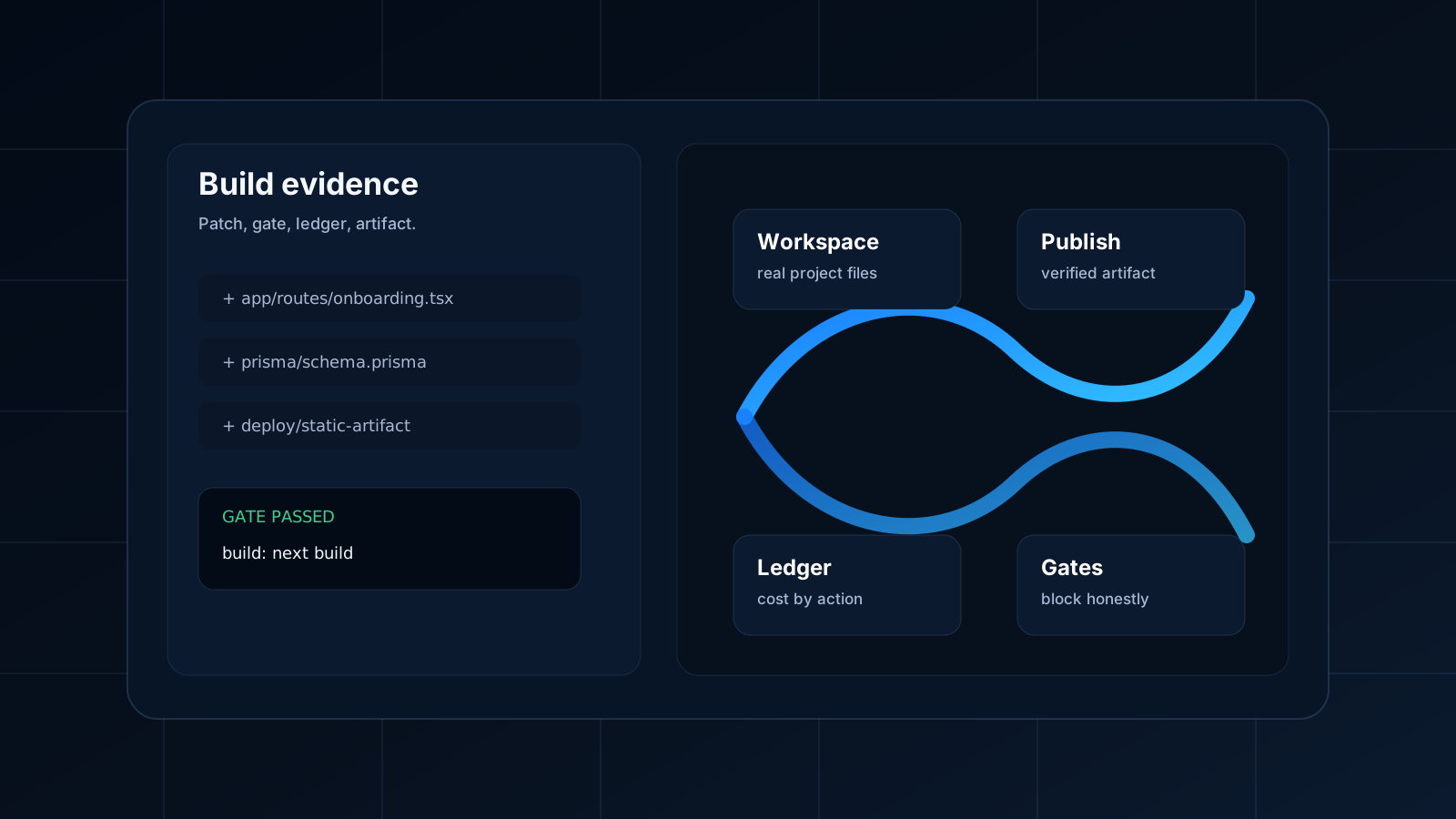
Every execution runs inside a real Linux Docker workspace. The AI proposes patches, not direct edits. Every expensive operation passes through ProfitGuard before it runs. A premium model call, a sandbox allocation, a security scan, a deploy step, and a retry loop each get checked first. The ledger records every cost line as it materializes.
Here is what each of those mechanics means in practice.
ProfitGuard before every expensive call. ProfitGuard is a gate, not a budget check. It runs before the spend, never after — blocking a call you already paid for is not a guard. It asks whether the step is funded and whether it is economically defensible, and returns one of: continue, degrade to a cheaper model, switch provider, pause for budget, reuse a blueprint, reuse a repair, or stop. If the wallet is short, the API returns 402 INSUFFICIENT_FUNDS with a top-up URL. The AI does not decide on its own to spend money.
Gate-verified patches. The AI generates a patch proposal rather than editing your files directly. Before it can apply, the patch runs an LLM critic and a fifteen-scanner security engine — Semgrep, Gitleaks, Trufflehog, Trivy, Govulncheck, OSV-Scanner, Syft, ScanCode, npm audit and others. Findings are shown with severity, file, line and rule. Critical and high findings block the build outright; medium and low surface as warnings. Nothing is applied that you did not see.
Append-only ledger. Every cost line is written to a ledger that is never updated and never deleted. Token spend, sandbox time, build minutes, deploy operations — all of it recorded per execution as a real double-entry accounting entry, not an estimate.
Hardened Linux workspaces. IronFlyer runs builds in Docker containers with full Linux environments. You can install real packages, run a real database, compile real binaries. The workspace is not a simulation. It is also not a shared playground: each workspace gets its own isolated Docker network, drops all Linux capabilities, sets no-new-privileges, and runs under explicit CPU, memory and process limits. The IDE port binds to localhost only.
Your deploy target, not ours. IronFlyer deploys to your own Vercel project, or produces a static artifact you host yourself. Custom domains are verified by DNS and get certificates issued and renewed automatically, and a domain binds to a deployment rather than to a project — so a rollback moves the domain with it. Production deploys require an explicit human approval by default.
---
Head-to-head: 5 specific capabilities
1. Cost control before the build starts
Bolt does not expose cost before or during a build. You see usage metrics in your account dashboard after the fact.
IronFlyer reserves wallet funds before any expensive operation begins, in the same database transaction that enqueues the work. The reservation comes from your prepaid balance, held in dollars rather than an invented credit unit. If the balance is insufficient, the operation does not start and you get a clear error with a top-up link.
2. The workspace environment
Bolt runs in a browser WebContainer. This means no native binaries, no persistent file system across sessions, no real operating system calls, and no real network access beyond browser-compatible protocols.
IronFlyer allocates a Docker container per workspace, on its own isolated network. The container has a real filesystem and persists across the session. You can run Postgres, Redis, background workers, and native build tools inside it. The AI has access to the same environment you would use to build the app yourself — with the capability, PID, CPU and memory limits that make it safe to hand a language model a shell.
3. Security scanning and the change record
Bolt edits code directly. The AI decides what to change and changes it. You can see the diff in the file tree, but the change has already happened, and nothing scanned it.
IronFlyer's AI proposes a patch. Security and quality gates run against the proposal automatically. Patches, gate runs, findings and approvals are stored, so a later reader can see what the AI proposed in which build and what the gates said about it.
4. Backend and full-stack support
Bolt is strong for frontend applications. Creating a backend service with real auth, a real database schema, background jobs, and webhook handlers in Bolt is possible but limited by the WebContainer constraint.
IronFlyer treats backend as a first-class build target, with production blueprints for Go HTTP APIs, Node/Express, NestJS, FastAPI and Flask alongside the frontend ones. Auth scaffolding, database migrations, API routes and background workers are within the build scope, and the AI runs real build commands in a real Linux environment to verify they work before proposing deployment.
5. Deployment targets
Bolt publishes to Bolt's hosting or to StackBlitz. Getting the code to your own infrastructure requires exporting and re-deploying manually.
IronFlyer deploys into your own Vercel project or produces a static artifact you can host anywhere, with your domain and your certificate. The deploy step is a node inside the gated pipeline — there is no path that ships without passing the security gate — and production promotion waits for a human approval.
---
When Bolt is the right choice
Bolt is fast. It is also genuinely good at what it does.
Use Bolt when you need a working frontend prototype in under an hour. When you are exploring an idea visually before committing to architecture. When you want to show a stakeholder how a screen could look without building a real system. When the project is a personal side project with no production reliability requirement.
Bolt is also a strong choice for developers who want to generate boilerplate — a starting point they will immediately port to their own local environment and maintain themselves. The export flow works. The code it produces is readable.
The constraint is the WebContainer. For frontend-only, browser-only work, that constraint rarely matters. For anything else, it matters a lot.
---
When to choose IronFlyer
Choose IronFlyer when the application you are building needs to be real.
Real means: a backend that runs a real process. Real means: a database that persists data between sessions. Real means: an authentication system that actually validates credentials and manages sessions. Real means: a deployment target that is not a preview URL.
Choose IronFlyer when you need cost accountability. When you are spending real money on AI compute and you want to know before a step runs whether it is worth the spend.
Choose IronFlyer when your team needs a record. When more than one person is working on the project. When you are building something that will be reviewed — by a technical co-founder, by an engineering lead, by an investor, by a future acquirer.
Choose IronFlyer when you have hit the Bolt ceiling. The most common profile is a founder who built a working prototype in Bolt, validated the idea, and now needs to turn it into a real product with a real backend, real auth, and a real deploy pipeline.
---
Frequently asked questions
Is IronFlyer a direct Bolt replacement?
Not in every use case. If you need a fast frontend prototype in twenty minutes, Bolt remains fast. IronFlyer is optimized for builds that need to reach production, not builds that need to look good in a demo. Think of IronFlyer as the next step after validation — when you have confirmed the idea and need to build the real thing.
Does IronFlyer support the same frontend frameworks as Bolt?
IronFlyer ships production blueprints for Next.js, React (Vite), Vue, Svelte and Angular, plus standard TypeScript and JavaScript frontends. Because it runs in a real Linux workspace, it is not constrained by what the browser can execute.
How does IronFlyer pricing compare to Bolt's subscription?
The models are different in kind: Bolt bills a monthly subscription against a token allowance, while IronFlyer's compute is drawn from a prepaid wallet held in dollars, reserved before each step and settled at real cost. Which works out better depends entirely on your build cadence. See IronFlyer pricing for the current plans and wallet terms — that page is the authority, not this one.
Can I migrate an existing Bolt project to IronFlyer?
Yes. Export your code from Bolt and import it into an IronFlyer project. The AI picks up the existing codebase and continues from there. The patch system works on existing code the same way it works on generated code — every change is a proposal that must clear the gates.
What is ProfitGuard and why does it matter?
ProfitGuard is IronFlyer's economic gate. It runs before any expensive operation — a premium model call, a sandbox allocation, a build, a deploy, a retry loop — and checks the wallet balance, the estimated cost, and whether the step is worth taking. It can allow the step, quietly move it to a cheaper model, switch provider, pause, reuse earlier work, or stop. Because the wallet is prepaid, there is no mechanism by which a build runs up a bill you have not already funded.
---
If you are building something that needs to be production-ready — not just prototype-ready — start a build in IronFlyer and see how the gate pipeline works on your first execution.
You might also want to read our comparison with Lovable and v0 to understand where IronFlyer fits in the broader AI builder landscape.